
Convert Linear Ft to Sq Ft Using Material Width
At 6 inches wide, 400 linear feet provides 200 square feet of coverage. Use the common-width table, separate mixed widths, and add waste separately.
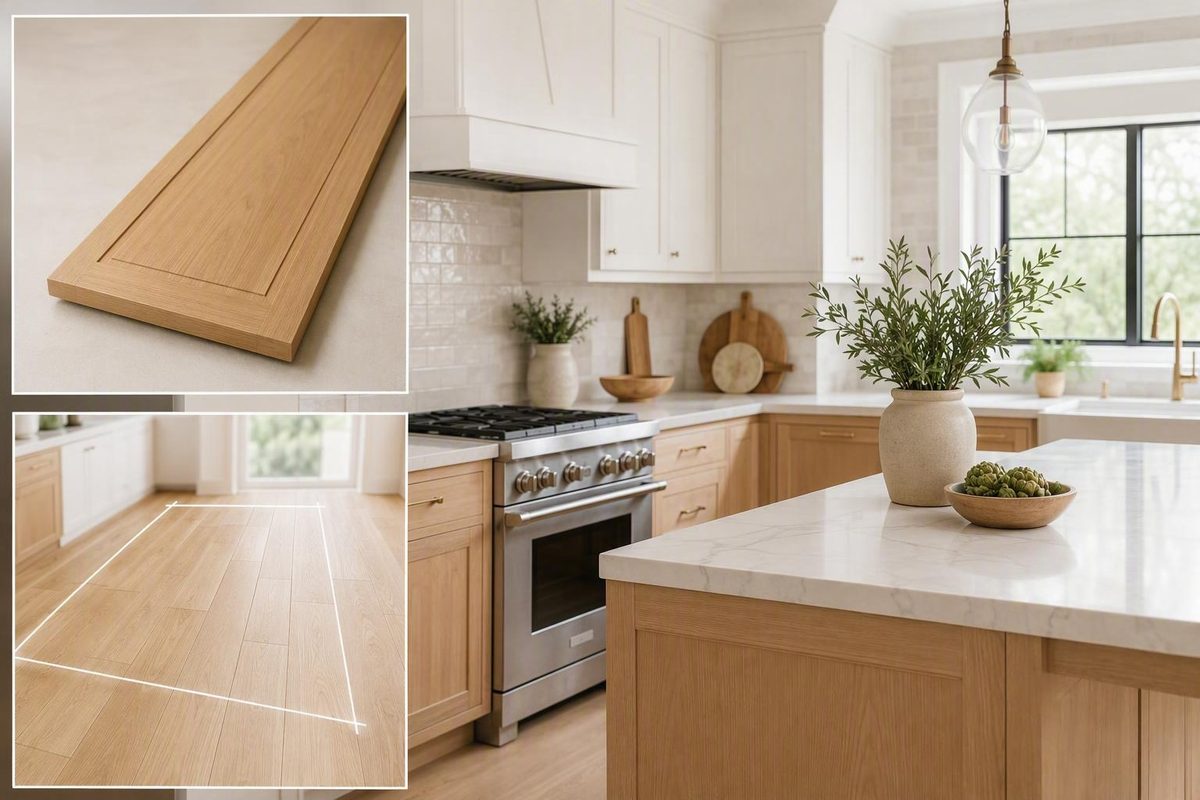
Turn a length measurement into square-foot coverage by adding the material’s width.
The conversion formula at a glance
To convert linear feet to square feet, multiply the linear footage by the material’s width in feet:
Square feet = linear feet × width in feet
If the width is measured in inches, use:
Square feet = linear feet × width in inches ÷ 12
Width is essential because linear footage records length only. It cannot determine area without a second dimension, such as material width or wall height. Both dimensions must also use compatible units before they are multiplied. Inch Calculator explains the same feet- and inch-based formulas.
For example, 100 linear feet of material that is 6 inches wide covers 50 square feet:
Square feet = 100 × 6 ÷ 12
            = 50 square feet
You can also convert the width first:
6 inches ÷ 12 = 0.5 foot
100 linear feet × 0.5 foot = 50 square feet
One linear foot covers one square foot only when the material is exactly 12 inches, or 1 foot, wide:
1 linear foot × 1 foot wide = 1 square foot
If the width changes, the area covered by each linear foot changes too.
Use this three-step process:
- Record the linear footage. Add together lengths only when the pieces have the same width.
- Identify and normalize the width. Keep it in feet, or divide inches by 12.
- Multiply length by width. The result is square feet.
Write the unit beside every measurement before calculating. This prevents an inch measurement from being treated as though it were already in feet.
Why linear feet and square feet are not directly interchangeable
A linear foot measures one-dimensional length. One linear foot equals 12 inches. A square foot measures two-dimensional area: a surface 1 foot long by 1 foot wide. Because the measurements describe different dimensions, there is no fixed conversion from one to the other without knowing the width. This measurement guide distinguishes linear footage from square footage and explains their common uses.
Consider two strips that are each 1 linear foot long:
- At 6 inches wide, the strip is 0.5 foot wide and covers 0.5 square foot.
- At 24 inches wide, the strip is 2 feet wide and covers 2 square feet.
1 foot × 0.5 foot = 0.5 square foot
1 foot × 2 feet   = 2 square feet
The lengths are equal, but the wider strip covers four times the area. The width in feet is therefore the conversion multiplier.
This is also why a shortcut such as “multiply linear feet by 3” is not universal. It works only for material that is 3 feet, or 36 inches, wide:
Square feet = linear feet × 3 feet
At that width, 10 linear feet covers 30 square feet. By contrast, 10 linear feet of 6-inch-wide material covers 5 square feet. The multiplier describes a particular width, not a general relationship.
The distinction appears frequently in purchasing and project planning:
- Trim, molding, borders, edging, and similar products may be measured by length.
- Flooring, wall coverings, and other surface materials may be estimated by area.
- Fixed-width rolls or boards may be tracked in linear feet even when the project requires a square-foot coverage estimate.
The purchasing unit does not change the geometry. If material sold by the linear foot must cover a surface, its usable width connects the stated length to the resulting area.
That distinction matters in kitchens as well. Cabinet runs, countertop edges, toe kicks, and molding may be described by length, while flooring and wall finishes are calculated by area. When planning around standard kitchen cabinet dimensions, keep each measurement in its proper unit rather than treating quantities along the same wall as interchangeable.
How to calculate square feet when width is in feet or inches
The calculation is simplest when both dimensions are written with their units.
When width is already in feet:
Linear feet × width in feet = square feet
For example:
15 feet × 2 feet = 30 square feet
The units confirm the result:
feet × feet = square feet
When width is in inches, use either of the following methods.
Method 1: Convert the width to feet first
Width in feet = width in inches ÷ 12
Square feet = linear feet × width in feet
Method 2: Combine the conversion and multiplication
Square feet = linear feet × width in inches ÷ 12
Both methods produce the same result. Converting the width first makes the units easier to inspect, while the combined formula is convenient for a calculator.
Example: 20 linear feet at 6 inches wide
First convert the width:
6 inches ÷ 12 = 0.5 foot
Then multiply:
20 linear feet × 0.5 foot = 10 square feet
The same calculation in one line is:
20 × 6 ÷ 12 = 10 square feet
The 20-linear-foot example and its 10-square-foot result are supported by the standard length-times-width method for a 6-inch-wide border. See the worked comparison of linear and square footage.
Example: 400 linear feet at 6 inches wide
Because 6 inches equals 0.5 foot:
400 × 0.5 = 200 square feet
Therefore, 400 linear feet of 6-inch-wide boards provides 200 square feet of geometric surface coverage. E&K Vintage Wood gives this same width-dependent example.
Why direct multiplication by inches is wrong
Suppose you write:
20 linear feet × 6 inches = 120
The result is not 120 square feet because the inputs use different units. The 6-inch width must first be converted to 0.5 foot, or the combined product must be divided by 12:
20 × 6 ÷ 12 = 10 square feet
Calling the unconverted result 120 square feet would overstate the correct area by a factor of 12.
An all-inches alternative for a rectangular piece
If both dimensions of a rectangle are measured in inches, multiply them and divide by 144:
Square feet = length in inches × width in inches ÷ 144
A square foot contains 12 × 12, or 144, square inches. For a rectangular piece measuring 24 inches by 36 inches:
24 × 36 ÷ 144 = 6 square feet
This method applies when both dimensions are in inches. It is different from the linear-foot shortcut, where the length is already in feet and only the width must be divided by 12. Aresco demonstrates the 24-by-36-inch calculation and the resulting 6-square-foot area.
Unit check
- Label every input as feet or inches.
- Confirm that length and width use compatible units.
- If length is in feet and width is in inches, divide the width by 12.
- If both dimensions are in inches, divide their product by 144.
- Confirm that the final unit is square feet.
Square feet per linear foot: a common-width reference table
For fixed-width material, the width in feet is also the number of square feet covered by each linear foot. The following values are calculated from the standard fixed-width formula; the 4-inch and 8-inch entries are rounded from one-third and two-thirds of a foot. A 36-inch-wide roll, for example, covers 3 square feet per linear foot because its width is 3 feet. Aresco documents that width-specific relationship.
| Width in inches | Width in feet | Square feet per linear foot | Coverage from 100 linear feet |
|---|---|---|---|
| 3 in. | 0.25 ft. | 0.25 sq. ft. | 25 sq. ft. |
| 4 in. | About 0.333 ft. | About 0.333 sq. ft. | About 33.3 sq. ft. |
| 6 in. | 0.5 ft. | 0.5 sq. ft. | 50 sq. ft. |
| 8 in. | About 0.667 ft. | About 0.667 sq. ft. | About 66.7 sq. ft. |
| 12 in. | 1 ft. | 1 sq. ft. | 100 sq. ft. |
| 24 in. | 2 ft. | 2 sq. ft. | 200 sq. ft. |
| 36 in. | 3 ft. | 3 sq. ft. | 300 sq. ft. |
For repeating decimals, retain the fraction or unrounded value during the calculation:
4 inches ÷ 12 = 1/3 foot
8 inches ÷ 12 = 2/3 foot
To use the table, find the material width and multiply the linear footage by the value in the third column. For example, 75 linear feet of 8-inch-wide material can be estimated from the rounded multiplier:
75 × 0.667 ≈ 50 square feet
The full formula verifies the result without rounding the width first:
75 × 8 ÷ 12 = 50 square feet
The multiplier remains reusable only while the width stays fixed. If one group of boards is 4 inches wide and another is 8 inches wide, calculate them with separate multipliers.
The 36-inch row also shows why multiplying by 3 is width-specific:
36 inches ÷ 12 = 3 feet
Every linear foot at that width covers 3 square feet. The same multiplier is incorrect for any other width.
Mixed widths, walls, and irregular project areas
A single length-times-width calculation works only when one width accurately represents the entire measured length. Mixed-width boards, multiple walls, tapered strips, and irregular surfaces should be divided into measurable sections.
Boards, strips, or rows with different widths
Group together pieces that have the same width. Calculate each group separately, then add the square-foot subtotals.
A reusable worksheet can follow this structure:
| Group | Linear feet | Width | Width in feet | Square-foot subtotal |
|---|---|---|---|---|
| A | ||||
| B | ||||
| C | ||||
| Total |
For example:
- 60 linear feet of 4-inch-wide boards
- 80 linear feet of 6-inch-wide boards
- 25 linear feet of 12-inch-wide boards
Calculate each subtotal before adding:
| Group | Linear feet | Width | Width in feet | Square-foot subtotal |
|---|---|---|---|---|
| 4-inch boards | 60 ft. | 4 in. | 4 ÷ 12 = 0.333… ft. | 60 × 4 ÷ 12 = 20 sq. ft. |
| 6-inch boards | 80 ft. | 6 in. | 6 ÷ 12 = 0.5 ft. | 80 × 0.5 = 40 sq. ft. |
| 12-inch boards | 25 ft. | 12 in. | 12 ÷ 12 = 1 ft. | 25 × 1 = 25 sq. ft. |
| Total | 165 ft. | — | — | 85 sq. ft. |
Do not add the widths together. An average width is also inappropriate unless it is weighted by the corresponding lengths. Separate rows make the calculation easier to check. Trestlewood’s multi-row calculator uses columns for width, linear feet, and square feet, although calculator results should still be verified independently.
Walls and multiple surface sections
For a wall, height supplies the second dimension:
Wall area = wall length × wall height
A wall measuring 12 feet long and 8 feet high has an area of 96 square feet:
12 feet × 8 feet = 96 square feet
For multiple walls, calculate each rectangular section and add the results. Openings should be subtracted only when the material will not cover them. Thin Brick Company’s wall guide documents the 12-by-8-foot example and notes that treatment of openings depends on the project.
When an opening should be excluded:
Net area = gross surface area − total opening area
Measure each excluded door or window as a rectangle, add the opening areas, and subtract that total from the gross wall area.
Irregular areas and changing widths
For an L-shaped or stepped area, divide the surface into rectangles or squares. Calculate each section and add the results. A labeled sketch helps prevent omissions and double counting.
If width changes along a strip, do not apply one endpoint width to the entire length. Divide the run into smaller sections and calculate each section independently. Smaller sections generally provide a more faithful estimate when the change is irregular.
Overlapping or profiled materials
Check the product specification to determine whether the calculation should use:
- Actual physical width
- Exposed face width
- Installed coverage width
- Another manufacturer-defined measurement
Use the dimension that corresponds to the surface coverage being estimated rather than automatically relying on nominal width.
How to convert square feet back to linear feet
If you know the area and need to determine the required material length, rearrange the original formula:
Linear feet = square feet ÷ width in feet
If width is in inches, either divide it by 12 first or use:
Linear feet = square feet × 12 ÷ width in inches
Suppose you need to cover 120 square feet with 3-inch-wide boards.
Convert the width:
3 inches ÷ 12 = 0.25 foot
Then divide the area by the width:
120 square feet ÷ 0.25 foot = 480 linear feet
The exact geometric requirement is therefore 480 linear feet at the stated width. Inch Calculator provides this supported reverse-conversion example.
The inch-width shortcut gives the same result:
120 × 12 ÷ 3 = 480 linear feet
Verify the calculation by returning to the forward formula:
480 linear feet × 0.25 foot = 120 square feet
The reverse result is the theoretical length required before purchasing considerations. It does not automatically include:
- Cuts or offcuts
- Defects or damaged pieces
- Layout losses
- Irregular edges
- Pattern or matching requirements
- Fixed board lengths
- Package, carton, bundle, or roll quantities
Do not round the geometric requirement down when placing an order. First calculate the exact length, then adjust upward as necessary to match the way the product is supplied and any project-specific allowance.
From exact coverage to a practical material estimate
The conversion formula gives geometric coverage. It describes how much surface a stated length and usable width can cover under ideal arithmetic conditions. It does not necessarily state how much material should be purchased.
Cuts, defects, irregular edges, layout choices, pattern matching, and installation waste are separate considerations. Their effects vary by product and project, so there is no universal overage percentage that belongs in the conversion formula. E&K Vintage Wood, for example, states that its calculator’s coverage result does not include material waste.
Before estimating a purchase, confirm what the stated product width represents. It may be:
- Nominal width
- Actual measured width
- Visible face width
- Installed or exposed coverage width
- A manufacturing dimension not intended for coverage calculations
This distinction is especially important for overlapping and profiled products. If the installed coverage width is smaller than the nominal width, using the nominal figure will overstate the area the material can cover.
Use this measurement checklist:
- Measure twice. Recheck both length and width.
- Label the units. Record whether each measurement is in feet or inches.
- Inspect the full run. Look for tapers and width changes.
- Use the applicable coverage width. Consult the product specification where necessary.
- Separate different widths. Give each width group its own calculation.
- Keep unrounded values. Round only after adding the subtotals.
- Handle openings deliberately. Subtract only surfaces the project will not cover.
- Verify reverse calculations. Multiply the required length by the width to recover the original area.
- Apply purchasing constraints last. Account for fixed lengths or package quantities after calculating exact coverage.
- Show allowances separately. Do not hide waste or overage inside the geometric result.
A simple worksheet can include:
| Field | Purpose |
|---|---|
| Linear feet | Total length for one fixed-width group |
| Width value | Numerical material width |
| Width unit | Explicit choice of inches or feet |
| Square-foot result | Exact geometric coverage |
| Additional rows | Separate calculations for other widths |
| Total coverage | Sum of the square-foot subtotals |
| Optional allowance | Separate project-specific adjustment |
| Adjusted estimate | Coverage plus the stated allowance |
The width-unit field should be explicit. Ambiguous labels create a factor-of-12 risk when a width entered in inches is interpreted as feet. Any optional allowance should also appear separately so that the reader can distinguish geometric coverage from a purchasing adjustment.
When using a commercial calculator, test it with a simple case:
Linear feet: 100
Width: 6 inches
Expected result: 50 square feet
If the calculator does not return 50 square feet—or does not clearly identify the width unit—inspect its settings and assumptions before relying on it.
The independent check remains:
Square feet = linear feet × width in feet
or:
Square feet = linear feet × width in inches ÷ 12
Can you convert linear feet to square feet without knowing the width?
No. Linear feet measure length, while square feet measure area. You need a second dimension, usually material width or wall height, to calculate exact square footage.
A typical or assumed width may provide a rough planning estimate, but it is not an exact conversion.
How many square feet are in one linear foot?
It depends entirely on the width. The square-foot coverage of one linear foot equals the material’s width expressed in feet.
One linear foot equals one square foot only when the material is exactly 1 foot wide.
What is the formula when the material width is measured in inches?
Use:
Square feet = linear feet × width in inches ÷ 12
Dividing by 12 converts the inch-based width to feet. You can perform that conversion before multiplying or combine both operations in one equation.
How do I calculate square footage for boards or rows with different widths?
Calculate each fixed-width group separately:
Group area = group linear feet × group width in feet
Then add all group areas:
Total area = sum of the square-foot subtotals
Keep unrounded values for each group until the final total.
Does the conversion include waste or extra material for cuts?
No. The formula calculates geometric coverage only. It does not automatically include cuts, defects, offcuts, irregular edges, layout losses, pattern matching, or package rounding.
Calculate exact coverage first. Then add a separate allowance appropriate to the product and project.
The essential rule is straightforward: identify the material’s usable width, express it in feet—or use the inch-width shortcut—and multiply it by the linear footage. Calculate separate subtotals when widths differ, verify reverse calculations when estimating required length, and keep exact geometric coverage separate from purchasing allowances.